Ambition and passion
of Château Peyrabon
thus producing authentic wines that reflect the wonderful grape varieties of Peyrabon: Cabernet Sauvignon, Merlot, Cabernet Franc, and Petit Verdot.
For each vintage, an exceptional and authentic Château Peyrabon. ”

A castle with Renaissance architecture
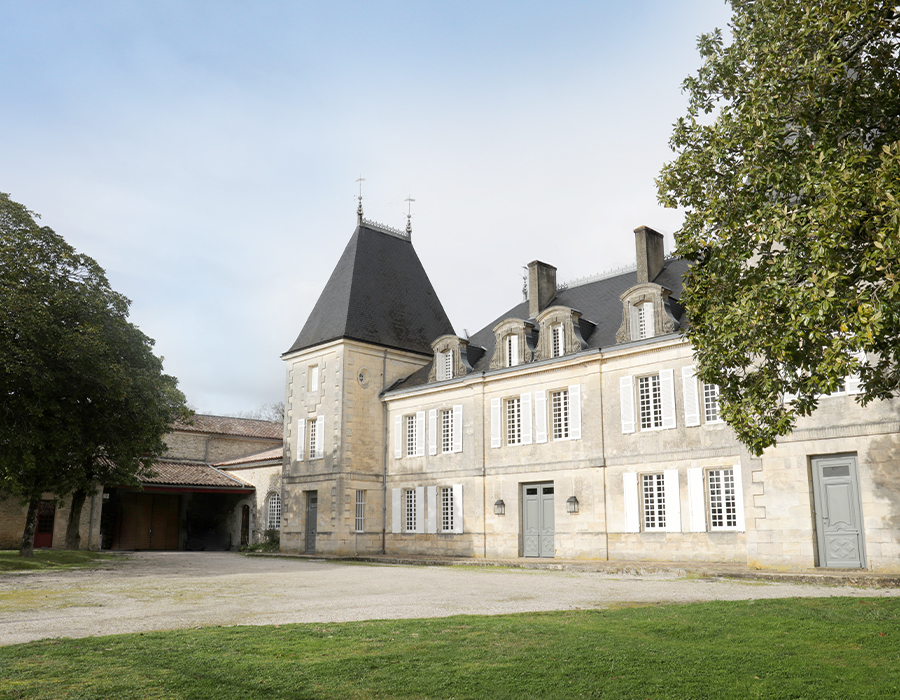
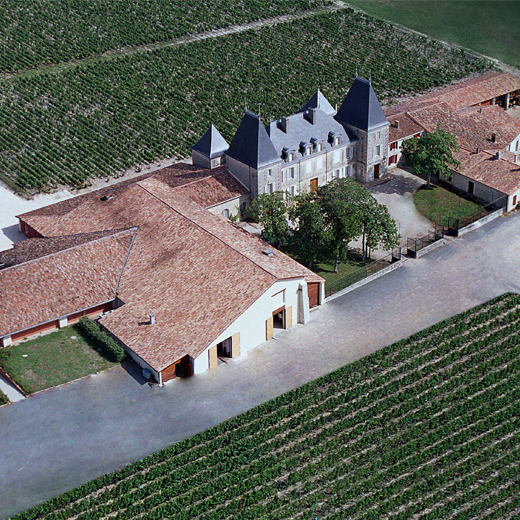
In the heart of the Médoc, Château Peyrabon is built amidst its vineyards, where a vine-lined driveway leads to this magnificent Renaissance-style building. This art form originated in Italy and was gradually introduced to Europe. In France, it was discovered during the battles against Italy in the 16th century.
Four towers were added to the main house in 1821, proudly lifting the Château towards the sky. It is crowned with a magnificent slate roof which, in fine weather, reflects the sunlight and makes it sparkle. After nearly 250 years, these simple and elegant forms remain as relevant as ever.
A wooded park surrounds the building where century-old magnolias bloom (certainly planted during its construction), completing the setting of this castle filled with history.
Château Peyrabon,
A story with a modern twist…
Following in the footsteps of Château Peyrabon
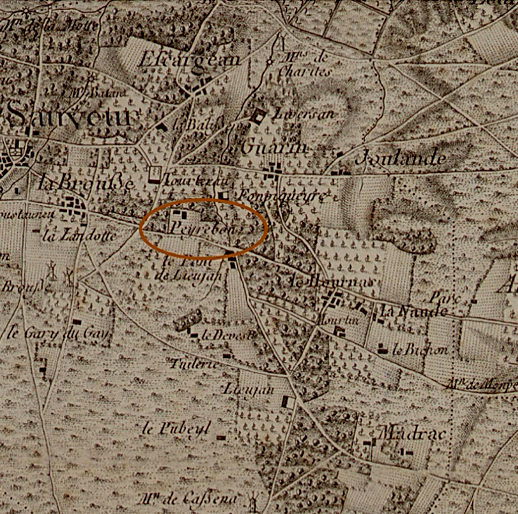 |
The earliest written record of the property dates back to 1766, when Château Peyrabon appeared on the Belleyme map, drawn in the 18th century by Pierre de Belleyme, the cartographer-engineer of King Louis XV. At that time, Château Peyrabon was shown as a wine estate in the commune of Saint-Sauveur-Pauillac. |
The towers of Peyrabon Castle
 |
Among these owners, François Badimont was one of the first to invest in the estate with significant renovation work to give the Manor House its current Renaissance architecture by building two towers on the south and north facades. |
A history inextricably linked to the Cru Bourgeois designation
 |
While the estate was in the hands of the wine merchant Arnaud Armand Roux, he quickly raised Château Peyrabon to prices equivalent to the Classified Growths he sold directly to the elite for export. He had, on his own authority, designated his wine as a “Classified Growth.” Immediately, he decided to sue the authors of the books “Traité sur les vins du Médoc” by William Franck, “La culture des vignes, la vinification et les vins dans le Médoc” by Armand D’Armailhacq, as well as the publisher Chaumas (works that promoted wines, particularly the Classified Growths of 1855), who had classified Château Peyrabon as “Ordinary Bourgeois / Cru Bourgeois,” hoping to defend Château Peyrabon in the increasingly influential 1855 classification… These publications risked impacting the reputation and price of the wine he had worked so hard to obtain… Arnaud Armand Roux’s case was dismissed, but he was given some hope that the Château might achieve a better classification in the future. He agreed to accept the highest classification awarded to his wine in the publications, “Bon Bourgeois / Cru Bourgeois Supérieur,” an experience that sparked a movement among the Bourgeois owners of the time to gain recognition, and it was only from 1932 onwards that the designation “Cru Bourgeois” appeared on the wine bottle labels. |
Queen Victoria’s visit to Château Peyrabon
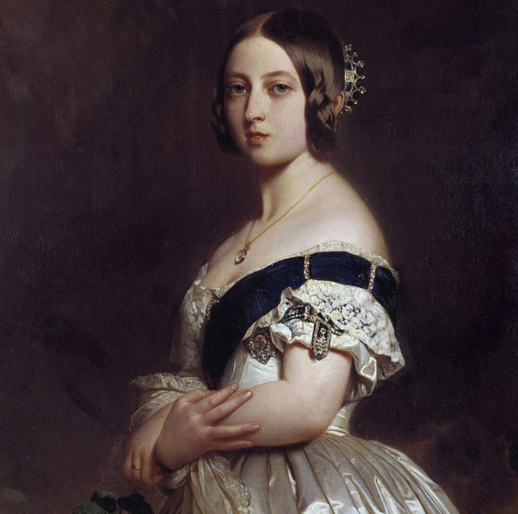 |
Queen Victoria (then Queen of the United Kingdom) attends a harp concert given in her honor in the small drawing room of the castle. |
The Château Peyrabon vineyard
 |
The Babeau family, who ran the estate for two generations from 1958 to 1998, made significant investments in the vineyard. After the devastating frost of 1956, they replanted almost the entire property. They also renovated the vat room and the wine cellar, then expanded the estate in 1977 by acquiring additional plots from their neighbor, Château Liversan. |
Millésima
 |
Upon its acquisition by Patrick Bernard, owner of Millésima (a Bordeaux wine merchant), a significant €2 million investment program was undertaken to modernize the property. Mr. Bernard and his team, led by Xavier Michelet, dedicated considerable effort to producing authentic, elegant, and silky wines, characterized by the fruit and freshness typical of Cabernet Sauvignon. |
The Castéja Heirs, owners
 |
In September 2022, the Castéja Heirs acquired the property from the Millésima group. Through this acquisition, the Castéja Heirs, already owners of several properties in Pauillac and Haut-Médoc, including the renowned Château Batailley and Château Lynch-Moussas, both 5th Growth Classified, aim to continue and expand the development of this property by leveraging their viticultural and commercial expertise. |